
The power of programmatic bridging digital and physical retail
TV-commerce didn’t kill brick-and-mortar. It just made it smarter. Today, shopping isn’t linear. It’s a fluid experience where consumers move effortlessly between digital and physical worlds. Some research online and buy in-store (ROPO), while others browse in-store but complete their purchase online later. But here’s the challenge: measuring how online influence translates into offline sales isn’t simple.
Take, for example, James who walks into a store, spots a sleek new coffee machine, and thinks, "Nice. But do I really need it?" He tinkers with it for a second, checks the price, then walks away, convincing himself that his current machine works just fine (even though it sputters like an old car engine every morning). A couple of weeks pass, and as he’s scrolling through his phone, there it is—an ad for the exact same coffee machine, staring right at him. "Huh. Maybe it’s a sign." He clicks, browses the site, and notices an option for local store pickup. No waiting and no delivery hassle. That seals the deal. He completes the purchase online and picks it up the same day from the store where it all started. That ad didn’t just remind him. It nudged him through a full-circle buying journey, seamlessly connecting in-store browsing with e-commerce convenience.
Just like James’ journey from in-store browsing to an online purchase, Sarah’s path starts with a DOOH screen in a parking lot, where she spots a pair of sneakers she likes. Later, while waiting at the dentist, a synced ad for the same sneakers appears on her phone. She clicks, adds them to her cart, but hesitates, unsure about the fit. The day after, she walks into a store, sees them again, tries them on, and finally buys them. Those ads weren't wasted; they were the first step in a journey that connected online influence with an in-store decision. The challenge for brands isn’t just delivering the right message, it’s connecting these moments and proving their impact.
Hybrid shopping is now the norm, with 45% of Brazilian consumers planning to blend physical and digital shopping experiences[1], while across the Atlantic, 40% of Dutch, German, and French shoppers research online before making major purchases[2]. More to the east, 73% of Southeast Asians also prefer a mix of online and in-store shopping[3], making it clear that the future of retail isn’t digital or physical. It’s both. Attributing a store visit or sale to a digital ad isn’t as simple as a last-click measurement. It requires a mix of attribution models, cross-screen tracking, and multiple data sources to capture the full journey. Relying solely on last-click is like judging a movie by its final scene, you miss everything that led up to it.
We’ll explore CTV’s role in e-commerce, cross-device and online-to-offline shopping, and 2025 trends. The goal: smarter targeting, better measurement, and ad spend that drives real action.
Turning e-commerce into a conversion machine
Optimizing touch points and minimizing cart abandonment
E-commerce is more than just an online storefront. It’s a dynamic ecosystem where data, advertising, and consumer behavior intersect. Every search, click, and abandoned cart tells a story, shaping how brands engage with potential buyers. But the journey doesn’t stop at checkout. Advertising fuels discovery, retargeting keeps brands top of mind, and cross-device behavior blurs the line between online browsing and offline purchases. A shopper might research a product on mobile, compare prices on a desktop, and make the final purchase in-store. In this fluid landscape, successful strategies connect digital intent with real-world action, ensuring that no matter where a customer starts their journey, the path to conversion is seamless.
One of the biggest challenges businesses face is cart drop-offs, when potential buyers abandon their purchases before completing checkout. In 2023, the global cart abandonment rate surpassed 70%[4], marking an increase of over 10 percentage points compared to previous years. To engage or re-engage potential buyers, brands need to go beyond the usual playbook. A cart abandonment doesn’t have to mean a lost sale. It’s an opportunity. A shopper who leaves an item in their cart might later see a high-impact, immersive CTV ad, reinforcing their interest in a non-intrusive, engaging format.
Connecting CTV ads to e-Commerce activity
Many viewers browse their phone while watching TV; tracking web traffic after a Connected TV (CTV) ad engagement. By linking brand exposure to online behavior, brands can measure the post-view journey and understand how CTV drives engagement, especially when paired with retail media. CTV can be more than just a brand awareness tool. It is becoming a performance-driven channel that influences online and offline actions.
But unlike mobile or desktop ads, CTV ads don’t come with a clickable call to action. So how can advertisers track CTV’s impact on web activity? By integrating CTV exposure with web analytics and programmatic technology, they can turn passive viewers into active shoppers. Through IP-based matching and cross-device attribution, brands can identify when a viewer watches a CTV ad and later visits the website, searches for the product, or takes action on another device, bridging the gap between big-screen engagement and measurable outcomes.
📺 TV sync – Recognizes when a CTV ad is viewed and attributes web visits from connected devices.
📺 TV Commerce – Identifying when viewers browse or buy a product, on mobile or other connected devices after seeing an ad on CTV.
📺 TV Growth – Syncs CTV advertising with in-app actions and purchases, for those advertisers using an app as storefront.
From interest to purchase: making every ad count
Instead of bombarding shoppers with static display ads, brands can diversify their approach, using innovative screens like CTV to keep products top of mind. But throwing ads into the digital world without tracking their real impact? That’s like fishing without bait. You might get lucky, but mostly, you’re just guessing. Pixel tracking is the backbone of advertising analytics for e-commerce, capturing product views, cart additions, and checkout attempts, giving brands insight into what shoppers are interested in. It’s how marketers retarget with promos, remind shoppers of abandoned carts, or push personalized deals that seal the purchase.
But there is a catch. Traditional pixel tracking stops at the digital doorstep. It tells you what a shopper clicks on but not what happens next. Did they buy from another retailer? Did they check out the product in-store before making the purchase? Shopping today? It’s a zigzag. Consumers don’t shop in a straight line anymore: they browse on one device, research on another, and buy wherever it’s most convenient. A last-click attribution model won’t explain why someone who clicked an ad three weeks ago suddenly makes a purchase in a physical store today.
Cross-device shopping and the online-to-offline connection
A shopper spots a coat on their phone during a lunch break, digs into reviews on their laptop that night, and then—two weeks later—walks into a store and buys it. Did that first online interaction matter? Absolutely. But traditional tracking would miss the connection. That’s where programmatic advertising and cross-device tracking change the game.
By combining digital data, location intelligence, and omnichannel tracking, brands can connect digital engagement to store action both online and offline. A shopper who abandons their cart online doesn’t just get another ad. They might receive a personalized offer directing them to the nearest store where the product is in stock.
Programmatic ties these touchpoints together, making sure brands don’t just throw ads into the void and hope for the best. Instead, they can:
👣 Track the full user journey – from the first contact to the actual sale, be it online or offline.
👣 Retarget smarter – remind the right person at the right moment, using cross-screen retargeting and synchronization.
👣 Prove what works – online-to-offline and cross-screen programmatic measurement so budgets fuel actual conversions.
By layering location data with purchase intent, programmatic advertising actively nudges buyers to act, whether online or in-store. The result? Smarter targeting, less wasted spend, and more budget going toward ads that actually drive sales.
How incrementality works
Measuring the impact requires incrementality measurement, which compares those who saw the ad vs. those who didn’t. 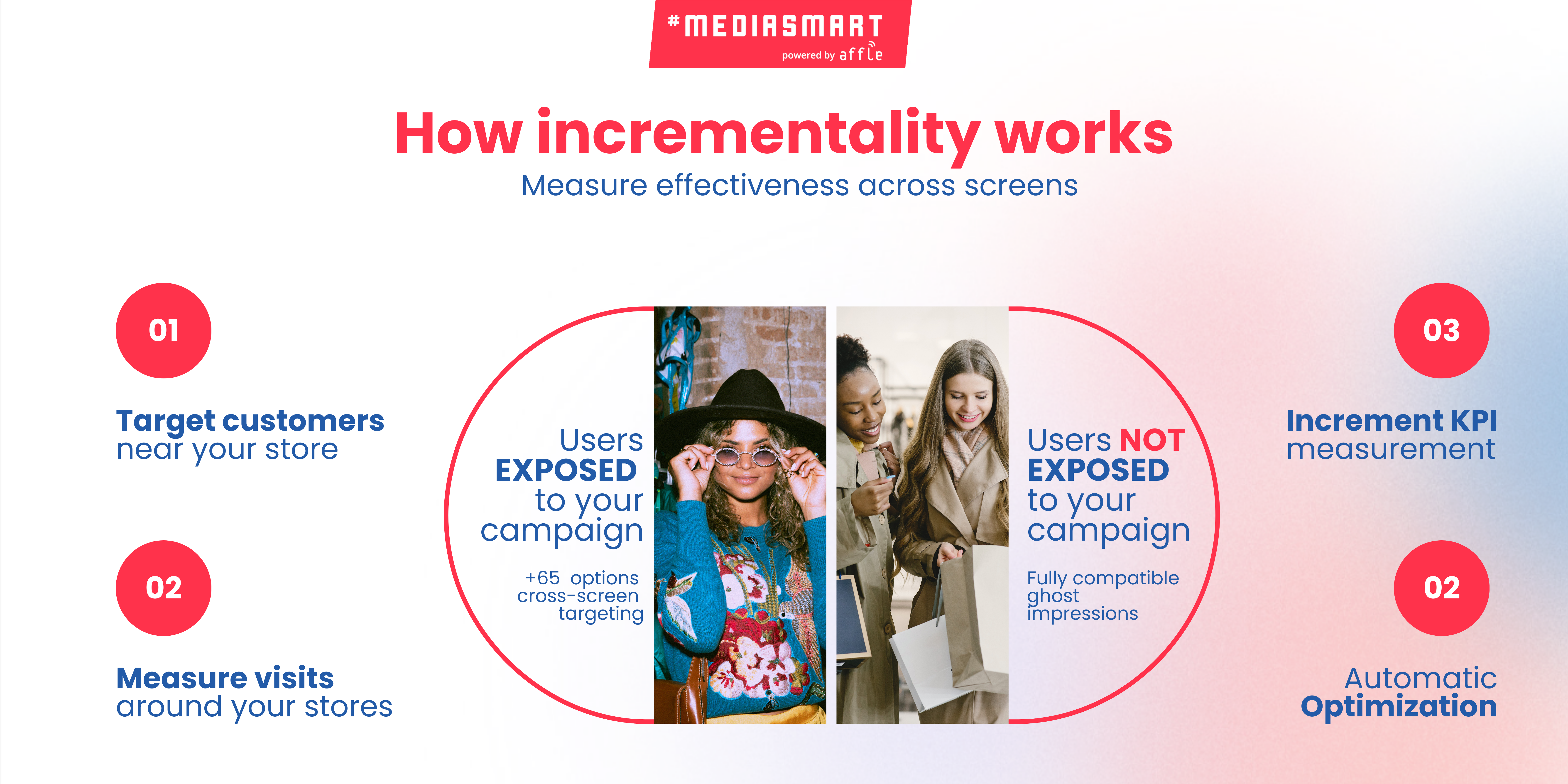
This approach ensures brands aren’t just guessing. They’re backing their campaigns with real data.
👣 Tracks cross-channel – Footfall attribution links digital engagement on Mobile, Desktop, CTV, or even DOOH ads with in-store movement.
👣 Eliminates guesswork – Proves what works, so budgets go where they matter.
The result? A clear, data-backed view of how digital campaigns drive real-world movement. It’s the difference between knowing an ad worked and just hoping it did.
The win: maximizing impact with smarter ad spend
Running a campaign is one thing—making sure it’s cost-effective is another.
Imagine showing car ads to someone who just bought a car last week. That’s a wasted impression. Instead of blasting promotions to everyone, predictive algorithms analyze data to identify users who are most likely to visit, ensuring ads land where they’ll have the most impact. It’s like replacing a megaphone with a one-on-one conversation, making every ad more relevant, and more likely to drive action. Paired with advanced technology like Attentia (patent-filed), brands can ensure reaching users more likely to engage.
AI-powered programmatic makes the most of location intelligence, determining when and where an ad will have the greatest impact. By factoring in real-world context, such as distance to a store, or peak visit times, ads are only delivered to the right users. This approach eliminates wasted impressions and maximizes efficiency, turning targeting into real-world store visits.
AI-powered ad formats: how Generative AI will transform advertising
Great ads don’t just happen—they’re tested, tweaked, and optimized until they hit the sweet spot. But old-school A/B testing? Slow, manual, and outdated before results even roll in. AI changes the game, automating creative testing at scale, refining headlines, visuals, and formats in real time.
Instead of running one static ad for weeks, AI allows testing multiple versions at once, instantly analyzing what drives engagement and adjusting creatives on the fly. If a carousel outperforms a static image, AI shifts spend. If a bold CTA gets more clicks, AI adapts mid-campaign. No more waiting. AI figures it out in seconds. Now, let’s say someone’s been searching for running shoes. AI sees their intent, detects they’re near a store, and serves up a personalized offer—right place, right time, right message. No more ad fatigue, just seamless nudges that make buying easier.
And it’s not just about performance, AI is changing the creative process itself. It’s not here to replace human creativity, but to enhance it, streamline production, and push creative boundaries. The fusion of AI and human-driven storytelling is raising the bar, ensuring ads aren’t just well-placed but visually compelling, hyper-relevant, and impossible to ignore.
Smart wrap up: Why programmatic is seamlessly bridging digital and physical shops
Shopping today is no longer a choice between online and offline. It’s a fluid, hybrid experience. Consumers research online, browse in-store, and complete purchases wherever it’s most convenient. The challenge for brands isn’t just delivering ads; it’s connecting moments, tracking impact, and optimizing every touchpoint.
Programmatic advertising plays a pivotal role in this evolution, helping brands measure and influence cross-channel behavior. Brands need an omnichannel strategy to connect the dots and drive conversions, taking into account how digital engagement translates into real-world action.
With AI-driven ad formats, cross-device tracking, and smarter attribution models, retailers can go beyond last-click metrics to truly understand what moves consumers. The future of retail isn’t just digital or physical—it’s both. And with programmatic, brands are equipped to turn every interaction into an opportunity. How? Capitalizing on:
👣 Real-time precision – Location intelligence ensures ads reach the right person at the right moment.
👣 AI-powered personalization – Data-driven insights fuel GenAI-tailored ads, while AI optimizes ad placements to ensure they are hyper-relevant and actionable.
👣 Cross-screen and online-to-offline measurability – Footfall attribution and incremental metrics bridge digital engagement with real-world impact, providing a clearer picture of ad effectiveness.
With AI and real-time location intelligence, every ad serves a purpose, nudging shoppers from curiosity to checkout, whether online or in-store. Today, the purchase doesn’t always happen where the journey starts, but programmatic sure helps to connect the dots.
Want to connect your online ads to actual sales?
Contact us to make it happen.
Sources
[1] Faturamento na Black Friday | E-Commerce Brasil
[2] Digital shopping behavior in Europe - statistics & facts | Statista
[3] 6 out of 10 plan to increase online shopping budgets | Marketech APAC
[4] Global digital shopping cart abandonment rate 2024 | Statista
[5] Towards Seamless Commerce | KPMG
[6] Impact of artificial intelligence adoption on online returns policies | Annals of Operations Research
[7] Geospatial analytics use cases | Deloitte Insights
[8] 2023 Retail TouchPoints Report | Mastercard Data & Services
[9] Geospatial analytics use cases | Deloitte Insights
[10] Touchpoints and the Omnichannel Revolution | BCG
[11] Marketing 2.0: Embracing The AI-Powered Future | Forbes
[12] Location Intelligence Market Size, Statistics Report 2024-2032 | GMI
[13] Unlocking Value with Location Intelligence | BCG
[14] Small Screens, Big Impact | Forbes
[15] CTV ad dollars are going to waste | eMarketer